New Brunswick — The Picture Province
Capital: Fredericton · Population: approximately 850,000 · Joined Confederation: 1867
New Brunswick tends to be the least-visited of the Maritime provinces, which is unfair but partly its own fault — it has three cities of roughly equal size and no clear single capital draw. What it does have is the Bay of Fundy, which is worth flying in for on its own; some of the best-preserved small-town architecture in the country; a lively Acadian coast along the northeast; and roads that empty out the moment you leave the Trans-Canada. It's a province for driving, for eating fried clams at a picnic table by the sea, and for listening to fiddle music in a pub in Caraquet on a Friday night.
A Compact History
The Wolastoqiyik (Maliseet), Mi'kmaq and Peskotomuhkati (Passamaquoddy) peoples have lived along the rivers and coasts of what is now New Brunswick for more than 10,000 years. French settlers arrived in the 1600s and built Acadia along the Bay of Fundy. After the expulsion of the Acadians in 1755, the British settled the land with New Englanders and, after 1783, with tens of thousands of Loyalists fleeing the American Revolution. Acadians returned in waves from the 1760s onward, settling primarily along the north and east coasts where they remain the majority today.
Fredericton
Fredericton is the provincial capital, population about 65,000 within city limits and 110,000 in the metro area. It sits inland on the St. John River about 90 minutes from Saint John and from Moncton. It's a quiet, tree-lined, university-and-government city with a disproportionately good downtown arts scene.
What should I do in Fredericton?
Walk the river. The Fredericton Walking Trail follows the St. John River for kilometres along the old rail line. The Beaverbrook Art Gallery, gifted to the city by the press baron Lord Beaverbrook (who grew up here), has one of the best small-city collections in Canada — Salvador Dalí's "Santiago El Grande" is the best-known piece. The Officers' Square downtown hosts free outdoor concerts all summer. The Garrison District, with its restored barracks and soldiers' quarters, houses the York-Sunbury Museum and a handful of craft breweries.
Is Fredericton worth a whole day?
Half a day, for most visitors. It's a pleasant small capital rather than a destination.
Saint John
Saint John (always spelled out in full — never "St. John," which refers to Newfoundland's capital) sits at the mouth of the St. John River on the Bay of Fundy. It's the oldest incorporated city in Canada (1785), population about 130,000 in the metro area. Ugly port-industrial on the outskirts; genuinely lovely brick-and-stone Victorian downtown in the centre.
What are the Reversing Falls?
Technically reversing rapids, not falls — the Fundy tides are so strong that they reverse the flow of the St. John River at the harbour mouth twice a day. You can watch it from a viewing platform at the Skywalk. It's worth the thirty minutes but don't plan an entire visit around it.
What about the rest of Saint John?
The City Market (open since 1876) is the oldest continuously operating market in North America and is the single best spot in the city to spend an hour. Market Square on the waterfront has restaurants and the New Brunswick Museum. The uptown walking tour through the 1870s commercial district is one of the best in Atlantic Canada — a surviving Victorian streetscape on a scale you don't see in Halifax or St. John's.
Moncton

Moncton is the largest metropolitan area in New Brunswick (metro population about 160,000) and the only majority-bilingual city in Canada outside of Quebec's borders. Its Acadian population is substantial (about a third of residents speak French at home), the University of Moncton is the largest French-language university in the country outside of Quebec, and the city has been growing steadily as both a regional service centre and a call-centre/tech hub.
Is Moncton worth visiting?
As a base for exploring the Bay of Fundy and the Acadian Coast, yes. As a destination in itself, it's mostly strip malls and suburbs. The Tidal Bore on the Petitcodiac River is a genuine phenomenon (a two-foot wave racing up the river twice a day at high tide), though it's smaller than it used to be because of a causeway built in the 1960s. Magnetic Hill — a visual illusion where cars appear to roll uphill — is a roadside attraction that delivers exactly what it promises and nothing more.
The Bay of Fundy & Hopewell Rocks
The Bay of Fundy has the highest tides in the world. The difference between low and high tide can reach 16 metres (53 feet) — enough water to flood the surface of a four-storey building twice a day. The best places to experience it are Hopewell Rocks (where you can walk on the ocean floor at low tide and kayak around the same rock formations at high tide), Fundy National Park (more rugged, with hiking and whale-watching out of Alma), and the drive around the Fundy Trail Parkway.
How long do I need? A full day at minimum. Ideally two — enough to see both low and high tide at Hopewell Rocks and to do at least one hike in the national park.
The Acadian Coast
The drive from Shediac up through Bouctouche, Miramichi, and Caraquet is the most distinctive part of the province. Acadian flags (blue-white-red with a yellow star) line the villages. The Village Historique Acadien in Bertrand is a live-interpretation museum of 19th-century Acadian life, worth a full day. Kouchibouguac National Park has warm-water beaches (Gulf of St. Lawrence water warms up in summer more than the Bay of Fundy water does) and a long coastal bike trail. Shediac calls itself the Lobster Capital of the World — the claim is disputed but the lobster rolls are legitimately excellent.
New Brunswick FAQs
Do I need to speak French?
No. English will get you by everywhere, but on the Acadian coast (Caraquet, Shippagan, Tracadie) French is the dominant language and a few words are appreciated. Moncton is functionally bilingual. Fredericton and Saint John are majority-English.
What's HST in New Brunswick?
15 percent — same as Nova Scotia and PEI (all three Maritimes harmonized at 15 percent in 2016).
Are there really covered bridges?
Yes. New Brunswick has 58 surviving covered bridges, more than anywhere else in Canada. The Hartland Covered Bridge, crossing the St. John River, is the longest covered bridge in the world at 391 metres. They were covered to protect the wooden deck from weather, which extended the bridge's life significantly.
Is New Brunswick a good drive-through province?
Yes, in the sense that you can drive through it pleasantly in a day. A more satisfying visit takes at least three days — one for Fundy, one for the Acadian Coast, one for the St. John River Valley.
Education & Post-Secondary Institutions
New Brunswick is Canada's only officially bilingual province, and its post-secondary system reflects this duality — offering strong French-language and English-language institutions ranging from research universities to technical colleges and specialized professional schools.
University of New Brunswick (UNB)
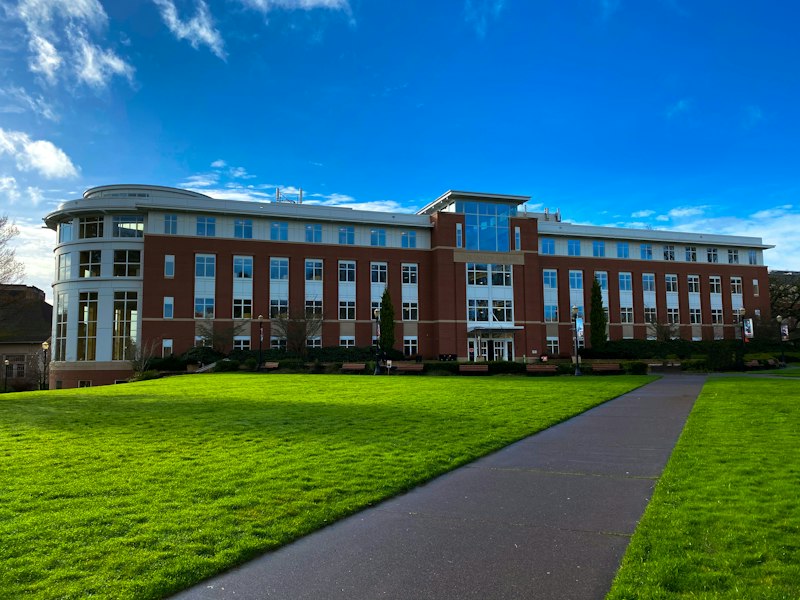
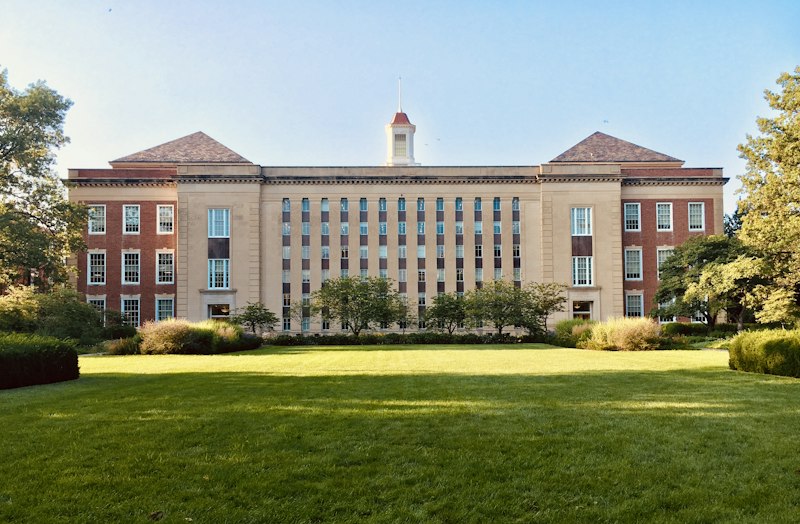
One of the oldest English-language universities in North America, UNB is known for engineering, forestry, law, computer science, and nursing. The Fredericton campus has a long history of producing engineers who work across Canada's resource industries. UNB Saint John focuses on business and health sciences.

Université de Moncton
The largest French-language university outside Quebec, a cornerstone of Acadian culture and identity. Known for its law school (the only French common-law school in Canada), administration, education, and nursing programs. Three campuses serve the province's Francophone communities.

Mount Allison University
Repeatedly ranked the top primarily undergraduate university in Canada by Maclean's. Known for fine arts, commerce, and sciences in a tight-knit small-town setting. Mount Allison has a remarkable record of Rhodes Scholars per capita and an outstanding fine arts tradition.

St. Thomas University
A small Catholic liberal arts university sharing a campus with UNB, known for social work, criminology, journalism, and Indigenous studies. STU has a strong reputation for community engagement and its journalism program feeds Atlantic Canadian media.
New Brunswick Community College (NBCC)
The province's English-language community college system with campuses in Saint John, Moncton, Fredericton, Woodstock, Sussex, Miramichi, and Bathurst. Offers practical programs in trades, IT, business, health, and early childhood education — the backbone of New Brunswick's skilled workforce.
Sports Teams & Athletic Culture
New Brunswick has no major professional sports franchise, but its junior hockey culture is fierce and connects the province's English and French communities in ways that politics sometimes can't.
 WCATS
WCATS
Moncton Wildcats
One of the QMJHL's most competitive franchises, playing at the modern Avenir Centre in Moncton. Situated in the heart of Acadian New Brunswick, the Wildcats draw bilingual crowds and have won the Memorial Cup.
SEA DGS
Saint John Sea Dogs
The Sea Dogs play at TD Station on Saint John's waterfront — one of the most atmospheric small arenas in junior hockey. The franchise consistently develops NHL talent.
TITAN
Acadie-Bathurst Titan
Based in Bathurst in the French-speaking north, the Titan represent the Acadian community's deep investment in hockey. The franchise has won the Memorial Cup and consistently develops talent from the Acadian Peninsula.
Culture, Arts & Identity
New Brunswick is the only province in Canada with two official languages in its constitution. The English-speaking south and west, and the French-speaking Acadian north and east, have produced distinct cultural expressions that occasionally intersect and occasionally argue — but the province as a whole has an intimacy and a groundedness that larger provinces rarely achieve.
Acadian Culture
The Acadian community of New Brunswick is among the most culturally vibrant French communities outside Quebec. Acadian French is distinct from Quebec French — older in some ways, with Norman and Poitevin roots. The Acadian Peninsula around Caraquet and the north coast is a working fishing and farming community that has maintained its language and Catholic parish culture through centuries of pressure. The Acadian World Congress, held every five years, brings together Acadian diaspora communities from around the world.
The Bay of Fundy
The Fundy tides — the highest in the world, rising and falling up to 16 metres in a single cycle — shape the landscape and the culture of the province's south coast. The Hopewell Rocks, where flower-pot rock formations stand exposed at low tide and disappear under water at high tide, are one of the great natural spectacles in eastern Canada. The fundy coastal hiking trail along the coast is demanding and extraordinarily beautiful.
Covered Bridges
New Brunswick has more covered wooden bridges than any other province in Canada — over fifty still standing. The bridges were covered to protect the wooden decking from weather, but they've become icons of a particular vision of rural Maritime life. Hartland's covered bridge, at 391 metres, is the longest covered wooden bridge in the world and is a genuinely moving structure to walk across.
Arts Scene
Fredericton hosts the Beaverbrook Art Gallery, one of Atlantic Canada's great museums, with a collection that includes Salvador Dalí, Lucian Freud and a permanent room dedicated to British portraiture. The gallery was the gift of Lord Beaverbrook, who was born in Ontario but identified with New Brunswick throughout his life as a press baron and wartime British cabinet minister.